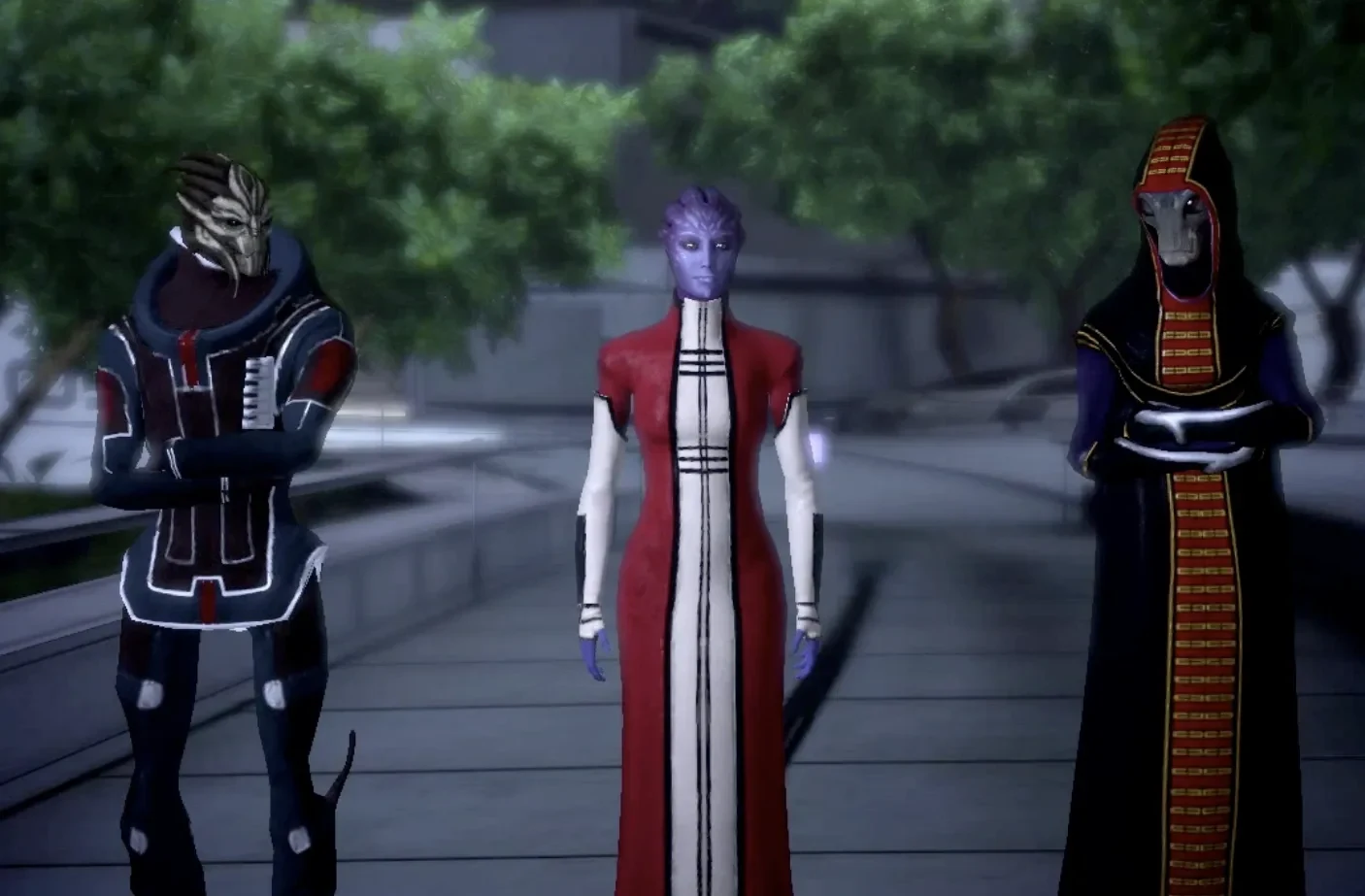
The Citadel Council is the face of galactic government in BioWare’s Mass Effect trilogy. New players often meet it as a row of holographic diplomats who second-guess Commander Shepard. That first impression is incomplete. The Council is a coalition balancing species interests, public fear, and classified history—while sitting on top of architecture older than any living politician understands.
This article explains how the Council is structured, what each founding culture wants, and why Shepard’s relationship with it feels tense from the opening hours. It stops before late-trilogy revelations that reframe the entire setting.
What the Citadel is
The Citadel is a massive space station at the heart of relay travel. In the first game, codex entries and dialogue describe it as:
- A hub for commerce, diplomacy, and military coordination
- Home to the Presidium, a ring of elite districts and embassies
- Guarded by Citadel Security (C-Sec), a police force with species quotas
The station’s design implies advanced technology, but early lore is careful: politicians treat the Citadel as a given, not a mystery to solve in chapter one.
Council structure in one page
At the start of Mass Effect, the Council has three seated members—one each from the asari, salarian, and turian species—plus support staff and ambassadorial corps.
| Role | Function in the story |
|---|---|
| Councilors | Final authority on Citadel law, Spectre appointments, and military posture |
| Ambassadors | Represent non-Council species and lobby for trade and defense treaties |
| Spectres | Elite agents with broad discretionary power “to preserve galactic stability” |
| C-Sec | Enforces station law; politically constrained when crimes touch embassies |
The Council does not run every planet. It sets norms: relay law, anti-piracy cooperation, and responses to threats that cross borders. Individual worlds keep local governments—Earth’s Systems Alliance negotiates as one power among many.
Why those three species?
The lore presents the Council as both pragmatic and historical:
- Asari — Long-lived diplomats with soft-power influence through trade and culture.
- Salarians — Fast-thinking intelligence community; credited with rapid technological and covert operations.
- Turians — Military reputation; their fleet posture shapes how the Council projects force.
Other major species—humans, quarians, krogan, and more—hold embassies but lack a rotating seat at the outset. That imbalance drives much of the political friction Shepard inherits.
Humans and the Council seat question
Humanity’s rise is recent by galactic standards. The Systems Alliance argues that human fleet contributions and colony economic weight deserve Council recognition. Council members counter that humanity is impulsive, expansionist, or unwilling to accept centuries-old compromise.
This is not abstract world-building. It changes:
- How quickly the Council believes Shepard’s reports
- Whether humans receive fleet support during crises
- How other species read human military actions on the news
Players who choose an Earth-born or Spacer Shepard still navigate the same institutional skepticism—the Council judges the species as much as the individual.
Spectres: diplomacy with a trigger
Spectres answer to the Council but operate without direct oversight in the field. The title is meant to recruit operators who can assassinate, negotiate, or sabotage as needed.
Shepard’s assignment is politically loaded:
- It signals the Council takes Saren and the geth threat seriously enough to arm a human.
- It also lets the Council distance itself if Shepard fails or oversteps.
Ambassador Udina and Captain Anderson represent competing human strategies—aggressive visibility versus institutional patience. Their arguments mirror real debates about whether influence comes from seats at the table or independent action.
C-Sec and the limits of law on the station
C-Sec is where lofty Council ideals meet street-level crime. Early missions show:
- Jurisdiction fights when suspects flee into embassy zones
- Species bias in patrol assignments
- Pressure to keep the Presidium spotless for tourists and investors
The Citadel feels safe compared to the Terminus Systems, but safety is curated. That gap matters when refugees, smugglers, and black-market tech flow through the wards.
Non-Council species with outsized influence
Krogan
After the Krogan Rebellions, the genophage limited krogan population growth. The Council treats krogan as a demilitarized underclass—dangerous, useful as mercenaries, but not trusted with fleet commands. Krogan storylines explore resentment of Council paternalism.
Quarians
The quarian diaspora lives aboard the Migrant Fleet, exiled after their AI creations—the geth—revolted. Council policy toward geth technology shapes quarian legal status. Their ambassadors argue for resettlement rights; other species fear another AI crisis.
Volus and elcor
Economic specialists often appear as negotiators rather than soldiers. The volus anchor trade metrics; the elcor speak with deliberate phrasing that other species misread in live debate. They illustrate how the Council’s economy can function even when military seats stay fixed.
How the Council learns about threats
Early Mass Effect plot hinges on who believes Shepard:
- Prothean beacons and ruins imply a cyclical extinction pattern.
- Saren, a rogue Spectre, complicates trust—if Spectres can fall, Council oversight looks naive.
- Intelligence agencies (especially salarian) may know fragments the Council has not shared publicly.
The Council’s default posture is risk management: avoid panic, avoid fleet mobilization costs, avoid admitting prior mistakes. Shepard’s urgency collides with bureaucratic half-measures—not because every Councilor is cowardly, but because their jobs reward stability metrics.
Public narrative versus classified archives
Codex entries and embassy gossip repeat a comforting story: the Citadel is the eternal center of civilization, relays are natural infrastructure, and the Council maintains peace.
Side conversations and later discoveries hint that archives are incomplete. For a lore reader, the gap between public history and excavated truth is the trilogy’s slow-burn horror. This article does not document endgame answers; it flags the pattern so new players notice foreshadowing in the first hours.
Reading Council scenes as a new player
When holograms interrupt Shepard, ask:
- Which species loses face if Shepard is right? Fear of embarrassment slows action.
- Who benefits from delay? Arms contractors, isolationist colonies, and rival Spectre candidates all gain time.
- What does the Council think the geth represent? To them, geth are a technology problem; to Shepard, they may be a symptom.
Those questions make Council meetings feel less like roadblocks and more like faction chess.
Frequently asked questions
Is the Council evil?
It is self-preserving. Individual Councilors can be sympathetic, arrogant, or pragmatic within the same scene. The institution prioritizes continuity over heroics.
Can Shepard replace Council members?
Player choices in critical missions change who sits on the Council by the end of the first game. The institution persists even when faces change.
Do I need to read every codex entry to understand politics?
No, but codex entries on Spectres, First Contact War, and genophage clarify why species distrust each other.
Does Mass Effect Andromeda use the same Council?
Andromeda shifts setting to another galaxy; Council politics are background lore for colonists, not the live government players negotiate with in that game.
Bottom line
The Citadel Council is a pressure vessel: three species steering a multi-species metropolis while older forces press from the margins. Shepard’s story hurts because the Council’s caution is sometimes wrong—but rarely irrational from its members’ seats. Watch the embassies, not just the holograms, and the galaxy’s politics become as memorable as its combat.