If a friend calls a game a Metroidvania and you nod without knowing why, you are not alone. The label gets attached to side-scrollers, action RPGs, and even 3D adventures. The useful definition is narrower: a Metroidvania is an exploration game where the map is the main character, and new abilities change what the map means.
Where the name comes from
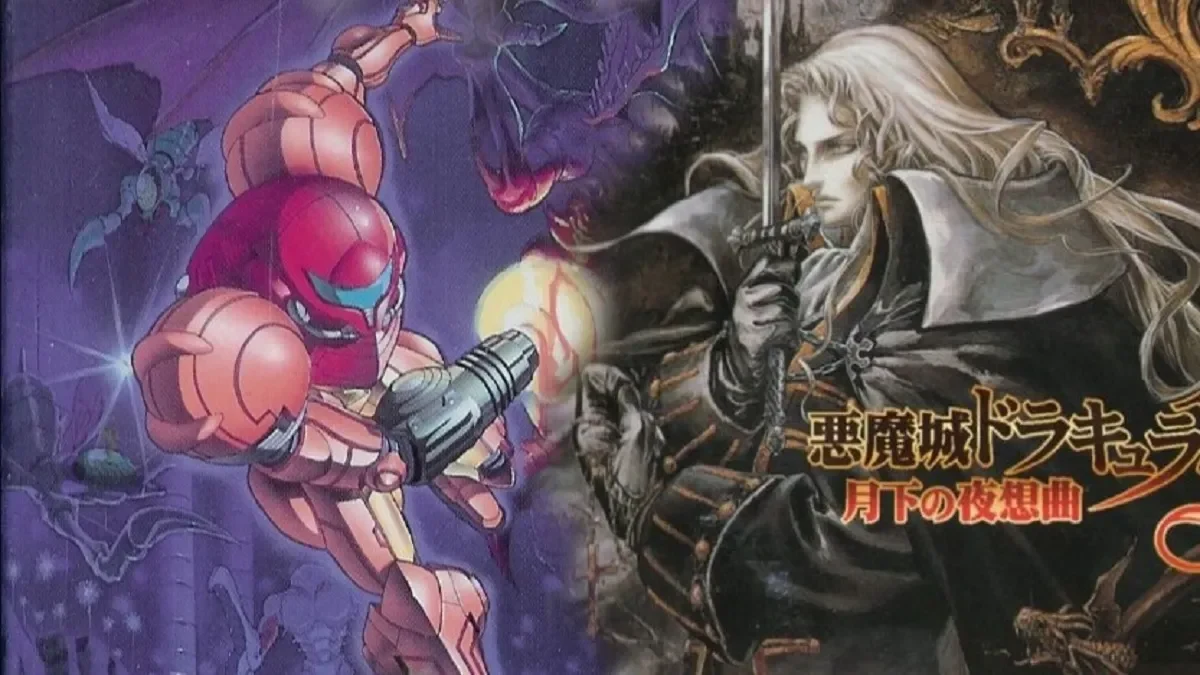
The portmanteau joins Metroid (Nintendo, 1986) and Castlevania (Konami’s long-running vampire-hunting series). Neither invented every idea in the genre, but two releases became reference points:
- Metroid established non-linear sci-fi exploration on a hostile planet, with upgrades that opened previously blocked routes.
- Castlevania: Symphony of the Night (1997) blended Castlevania combat with RPG progression, a large interconnected castle, and ability-gated shortcuts.
Designers and players reused those patterns until “Metroidvania” became shorthand for a structure, not a franchise license.
The core loop in plain language
Most Metroidvanias share a recognizable rhythm:
- You enter a large space with locked doors, high ledges, or hazards you cannot survive yet.
- You explore what you can reach, fight enemies, and find a meaningful upgrade or key item.
- You backtrack through earlier areas with new tools, discovering shortcuts and secrets.
- The world feels smaller as you learn it, even though the map does not shrink.
That loop is the genre’s signature. A linear platformer can have great levels; a Metroidvania asks you to re-read levels after you change.
What usually counts as Metroidvania
No official standards body stamps games with a genre ID, but players and critics converge on a handful of traits. A strong Metroidvania candidate typically includes most of the following.
Interconnected map
Areas connect without invisible loading screens between every room (or hide loads behind doors and elevators). You should be able to look at a map and think in terms of routes, not isolated stages.
Ability gating
Progress is not only “reach the next level.” It is “you cannot pass this acid pool until you have a double jump” or “this lift needs a power source you find elsewhere.” Gates teach you to remember landmarks.
Persistent world state
Doors stay open, switches stay flipped, and shortcuts remain available. The game respects your time by not resetting the whole map when you die in one room—though individual combat arenas may reset enemies.
Combat and character growth
Classic Metroidvanias pair exploration with real-time combat. Many modern examples add skill trees, equipment, or crafting. The exploration skeleton stays; the RPG layer varies.
What Metroidvania is not
Labels drift. These comparisons help separate adjacent genres.
Not every 2D action game
Celeste and Shovel Knight are excellent platformers, but their level-to-level structure is closer to classic stage design than to a single unfolding map. Some Shovel Knight campaigns add Metroidvania elements; the base game is not defined by them.
Not an open-world checklist simulator
Open-world games also reward backtracking, but they often scatter objectives across a continent-scale space with fast travel and quest logs. Metroidvanias usually keep the playable space bounded enough that you can learn it by heart.
Not a pure Soulslike
Souls games share gating and shortcuts, yet their tension model—lose currency on death, bonfire loops, opaque systems—comes from a different design tradition. A game can borrow from both; the label depends on which habits dominate.
Subgenres and modern twists
The genre did not freeze in 1997. Common variations include:
- Metroidvania roguelites — procedural map chunks with permanent upgrades between runs (Dead Cells, Rogue Legacy).
- Narrative Metroidvanias — story beats tied to specific regions (Hollow Knight, Ori).
- 3D Metroidvanias — first- or third-person spaces with the same gating logic (Metroid Prime, Axiom Verge 2’s 3D segments).
When shopping, read whether critics emphasize map literacy or run variety. Roguelite structure changes how much you are expected to memorize.
How to tell if a game will suit you
Ask three questions before you buy:
- Do I enjoy getting lost? Metroidvanias reward patience. Minimaps and objective markers vary; some games deliberately withhold direction.
- Do I like revisiting areas? If backtracking feels like filler, lean toward linear action games instead.
- How punishing is failure? Difficulty and checkpoint design differ widely. Check whether the game autosaves before boss fights and whether death costs currency or progress.
None of these questions require finishing a game to answer. Trailers, system requirements pages, and official feature lists usually state map structure and difficulty options plainly.
A short starter list by mood
These are widely discussed examples, not a ranked “best of” list:
| Mood | Example | Why players mention it |
|---|---|---|
| Classic 2D exploration | Super Metroid | The template many designers still cite |
| Gothic action RPG blend | Castlevania: Symphony of the Night | Equipment, stats, and castle layout |
| Hand-drawn challenge | Hollow Knight | Tight combat, large map, minimal hand-holding |
| Colorful precision | Ori and the Blind Forest | Emotional story plus ability gates |
| Roguelite structure | Dead Cells | Short runs, permanent unlocks |
Use the table as orientation, not homework. One finished Metroidvania teaches the genre faster than reading ten definitions.
Frequently asked questions
Is Metroidvania an official genre name?
It is a player and critic label, not a store category with fixed rules. Platforms may use tags like “exploration” or “platformer” instead.
Do Metroidvanias always use 2D graphics?
No. 3D games can follow the same exploration-and-gating design. The camera angle is less important than how the world opens over time.
Why do some Metroidvanias feel overwhelming?
Large maps without clear objectives can frustrate players who prefer guided stories. Check whether a game offers map markers, hint NPCs, or optional guidance before you commit.
Can a game be part Metroidvania?
Yes. Hybrid designs are common. Read reviews for whether exploration or linear levels dominate the middle hours.
Bottom line
Metroidvania describes a structure: one world, growing abilities, and routes that change meaning when you return. If that structure sounds satisfying, the label is a useful filter. If you prefer discrete levels and constant forward motion, other action genres will likely fit better—and that is a feature, not a failure of taste.